
1RM calculator
Estimate your one rep max from a set you’ve done, with or without RPE.
Estimated 1RM (e1RM)123.1 kg2 reps left
Your rep maxes
The most you could lift for each rep count with this 1RM, rounded to the nearest 2.5 kg.
| Reps | % of 1RM | Weight |
|---|---|---|
| 1 | 100.0% | 122.5 kg |
| 2 | 95.7% | 117.5 kg |
| 3 | 92.1% | 112.5 kg |
| 4 | 89.2% | 110 kg |
| 5 | 86.5% | 107.5 kg |
| 6 | 83.9% | 102.5 kg |
| 7 | 81.2% | 100 kg |
| 8 | 78.6% | 97.5 kg |
| 9 | 76.0% | 92.5 kg |
| 10 | 73.3% | 90 kg |
| 11 | 70.7% | 87.5 kg |
| 12 | 68.0% | 82.5 kg |
Video: how it works
How to use it
- Enter the weight and reps of a recent hard set.
- Pick the RPE you gave it. If you didn’t rate it, leave it on No RPE and the set counts as RPE 10.
- Read your estimated 1RM (e1RM). The table below shows what it means for other rep counts.
In the TopSet app
TopSet updates your e1RM live while you log a set, and every lift gets its own e1RM trend chart.
Download on the App Store →How the estimate works
TopSet uses OpenPowerlifting’s RPE formula. It works out how many reps the set was from a true max single (x below), then turns that into a multiplier: the share of your 1RM the set used.
If you pick No RPE, the set counts as RPE 10, with no reps left. One rep at RPE 10 is your 1RM.
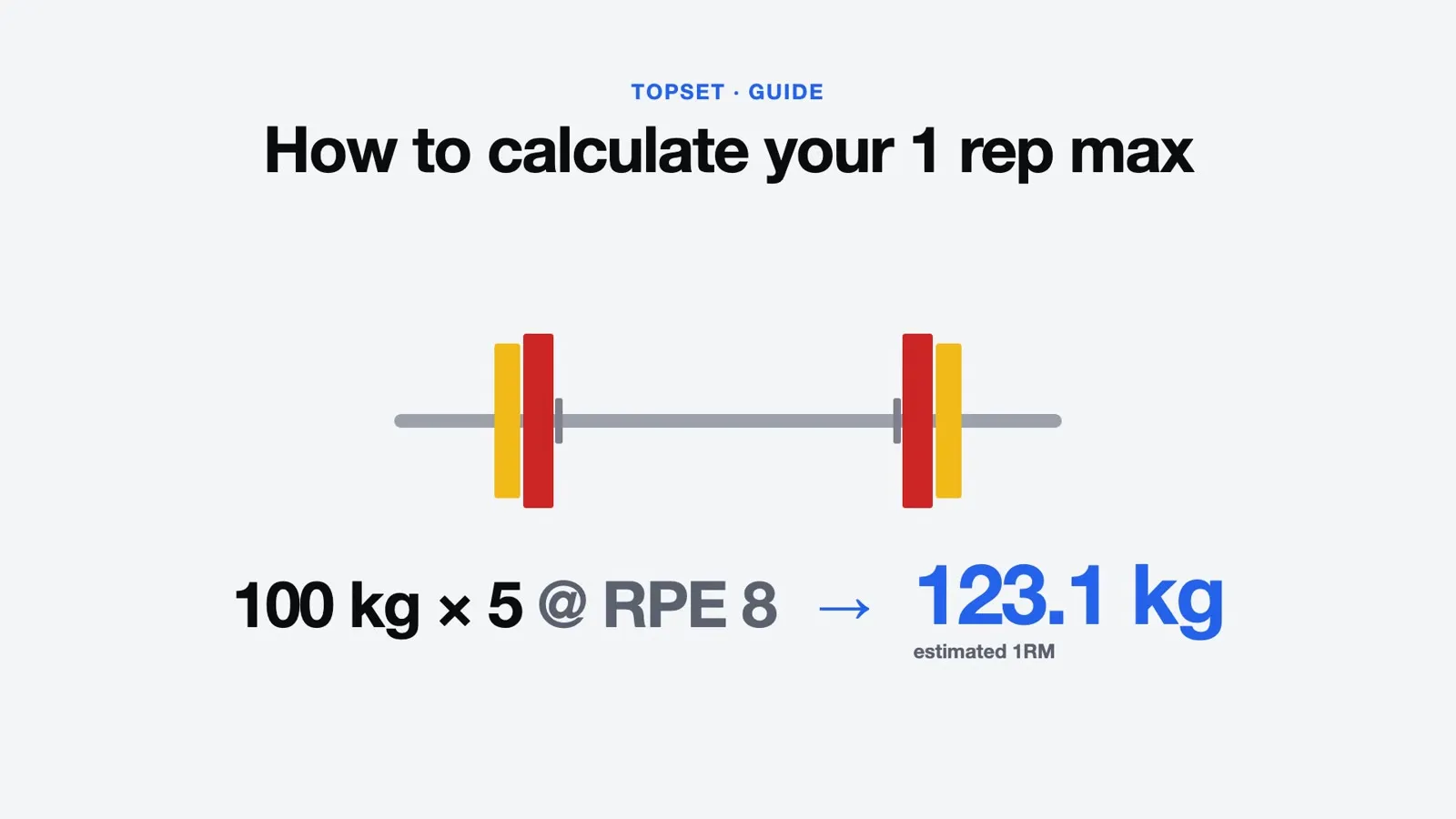
Example: 100 kg × 5 at RPE 8 gives x = 6, a multiplier of 0.8124 and an e1RM of 123.1 kg.
Heavy sets with low reps give the most reliable estimate. At 10 reps or more, it gets rough.
x = (10 − RPE) + (reps − 1)
x ≤ 2.92:  multiplier = (0.347619x² − 4.60714x + 99.9667) / 100
x > 2.92:  multiplier = (97.0955 − 2.64249x) / 100, never below 0.5
e1RM = weight ÷ multiplier